- Focus
- Power and machines
- Main tools
- MATLAB, Simulink, Equivalent-circuit modelling
- Headline result
- Induction motor efficiency at rated load: 80.32 %
Induction motor analysis with five starting methods, a DC motor position model, a PMSM versus WRSM comparison and a motor-selection case study for automated manufacturing.
Problem
Choosing and starting a motor well needs numbers, not rules of thumb. The task was to model machines from equivalent circuits, confirm them in Simulink and make defensible recommendations.
What I built
- A full analysis of a 5 HP, 460 V, 60 Hz, 4-pole Y-connected induction motor, compared across five starting methods: DOL, star-delta, autotransformer, rotor resistance and VFD.
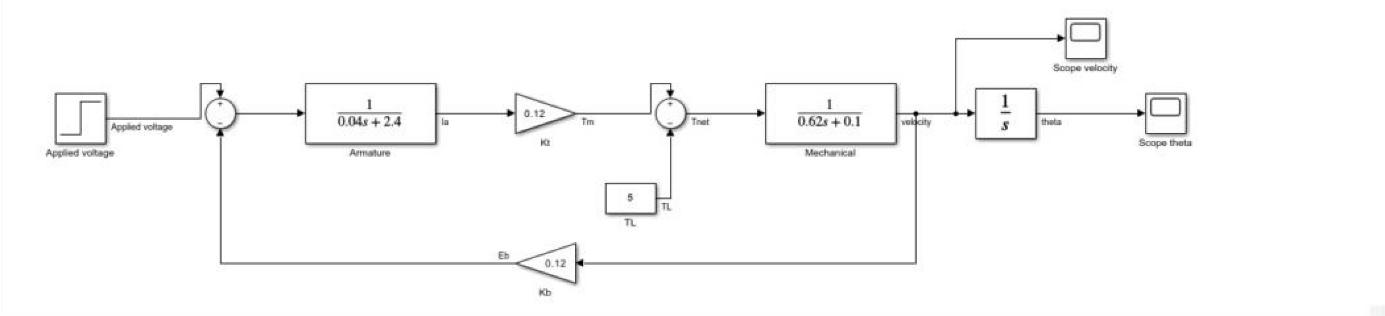
- A Simulink model validated against the theoretical calculations; a DC motor position model built from armature and mechanical transfer functions, torque and back-EMF gains and a load torque, with scopes for velocity and angle.
- A PMSM versus WRSM report covering SPMSM and IPMSM, field-oriented control and damper-winding starting.
- A case study recommending motors for conveyors, robotic arms and power-factor correction.
Tools and standards
- MATLAB
- Simulink
- Equivalent-circuit modelling
Result
The Simulink model matched the hand calculations, and the comparison gave application-specific motor recommendations.
| Metric | Value | Source |
|---|---|---|
| Induction motor efficiency at rated load | 80.32 % | Author's engineering portfolio (PDF) |
| Rotor speed | 1760.40 rpm | Author's engineering portfolio (PDF) |
| Stator current | 7.90 A | Author's engineering portfolio (PDF) |
| Power factor | 0.737 lagging | Author's engineering portfolio (PDF) |
| PMSM versus WRSM efficiency | 88.3 % vs 78.9 % | Author's engineering portfolio (PDF) |
Visuals
Sources
- Author's engineering portfolio (PDF)
- Author's MATLAB and Simulink model files