Brand and web
Vintage Click website
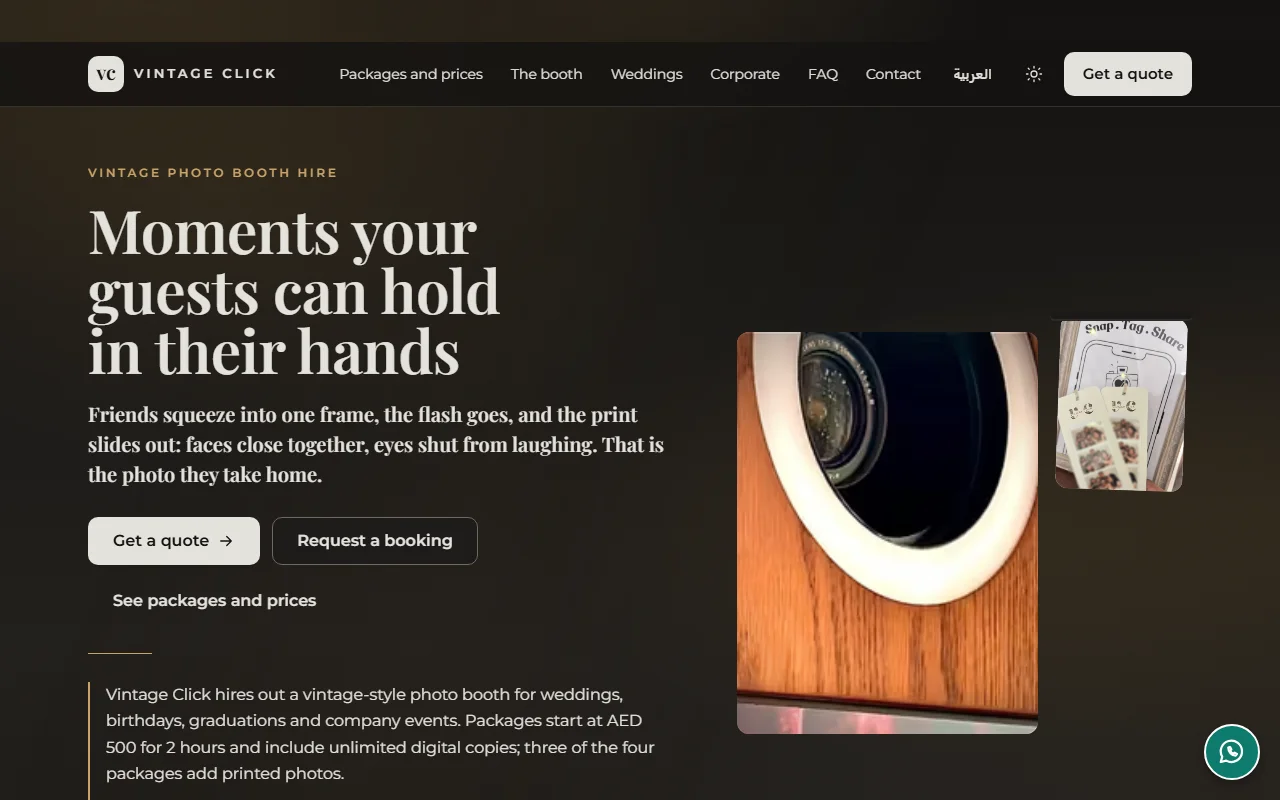
A fast, bilingual (English and Arabic) marketing site with prices, packages and a quote form that sends enquiries straight into the ERP.
[ + ]Introducing
Gian Melchor Gella
Electrical engineering student who builds the software that runs a business
HND Electrical & Electronic Engineering
University of Bolton, Ras Al Khaimah
02 / Projects
7 selected builds across engineering and business software, each with the real numbers behind it.
Brand and web
A fast, bilingual (English and Arabic) marketing site with prices, packages and a quote form that sends enquiries straight into the ERP.
Sustainable energy
A solar-powered, fully autonomous irrigation system for a rooftop garden, designed to fight the urban heat island effect in Dubai and built for 225 AED against an 800 AED target.
AI assistant
Built and tested, pilot not startedA safe-by-design assistant that answers routine customer questions from an approved fact sheet and hands anything uncertain, or any booking, to a person.
Business software
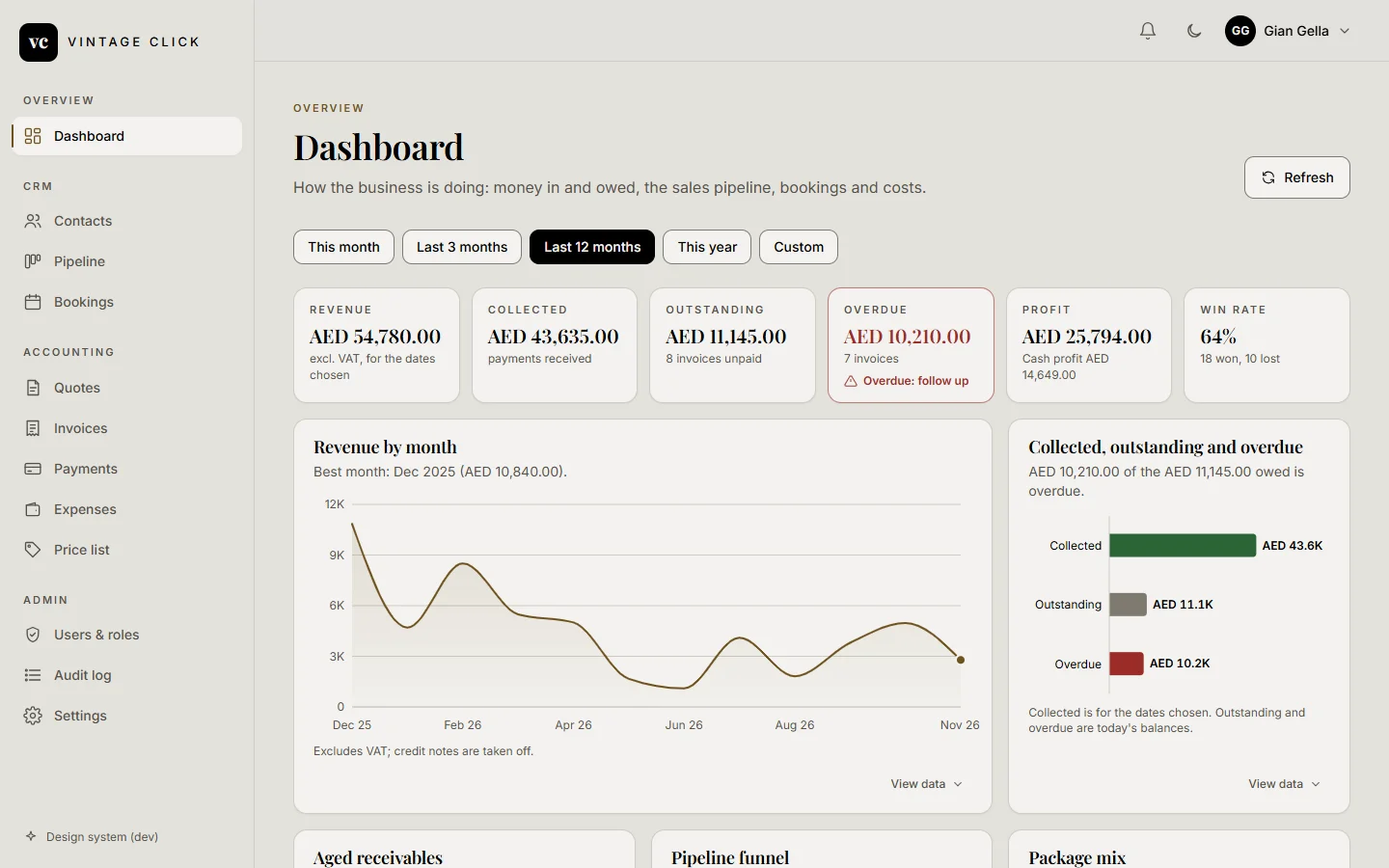
A secure web app that takes a photobooth business from enquiry to quote, booking, numbered invoice and payment, with dashboards, roles and an audit trail.
Power and circuits
A low-noise linear bench power supply with a true 0 V output, designed and simulated in Multisim, with a SolidWorks casing and drawings.
Power and circuits
Induction motor analysis with five starting methods, a DC motor position model, a PMSM versus WRSM comparison and a motor-selection case study for automated manufacturing.
Automation
Ladder-logic control of a hydraulic excavator arm that sorts four rock types, with safety interlocks and Modbus TCP/IP monitoring.
See all 14 projects, including coursework and smaller builds
03 / Approach
Simulate before buildingCircuits and machines are modelled in Multisim and Simulink and checked against hand calculations before anything is made.
Build with checksThe Vintage Click ERP carries a large automated test suite, and the WhatsApp assistant was safety-tested on 43 live cases.
Show the numbersEvery figure on a project page cites its source, and anything simulated here is labelled as simulated.
Scroll to move through the parts, or use the buttons.
04 / Workbench
These are the things I build, running live in your browser. Each one is a simulation of textbook physics or of a workflow from my projects. The moving plots are models, not recordings; the numbers I measured or tested myself are in the "Real values" panels and on the project pages, each with its source.
INSTRUMENT 01
Three supply phases 120 degrees apart: the starting point of every induction-motor study in my Simulink work. Drag the frequency and watch the period change.
The live version of this instrument needs JavaScript.
INSTRUMENT 02
The stator field spins at Ns = 120 f / P. The rotor follows a little slower. Slip is held at 2.2 %, the operating point of the 5 HP, 460 V, 60 Hz, 4-pole motor in my report (1760.40 rpm). Spin is slowed down so you can see it.
The live version of this instrument needs JavaScript.
| Quantity | Value | Where it comes from |
|---|---|---|
| Rotor speed (5 HP, 460 V, 60 Hz, 4-pole) | 1760.40 rpm | Induction motor report, equivalent-circuit analysis checked in Simulink |
| Stator current | 7.90 A | Induction motor report |
| Power factor | 0.737 lagging | Induction motor report |
| Efficiency at rated load | 80.32 % | Induction motor report |
INSTRUMENT 03
The ideal LM317 relation, Vout = 1.25 (1 + R2 / R1), with R1 = 240 ohm. A bare LM317 cannot go below 1.25 V; my supply adds a negative rail to reach a true 0 V. Formula only, not measured values.
The live version of this instrument needs JavaScript.
| Quantity | Value | Where it comes from |
|---|---|---|
| Rectified input (simulation probe PR2) | 33.6 V | Multisim schematic of the 0 to 30 V supply, probe readout |
| Output (simulation probe PR1) | 30.8 V, 16.9 mV peak-to-peak ripple | Multisim schematic of the 0 to 30 V supply, probe readout |
| Repeatability | +/-10 mV across 0 to 30 V | Power supply write-up in my engineering portfolio |
| Load regulation | 0.01 % | Power supply write-up in my engineering portfolio |
| Output noise | under 1 mV RMS | Power supply write-up in my engineering portfolio |
INSTRUMENT 04
A series RLC circuit with the values from my Multisim schematic (250 ohm, 650 H, 10 V rms) and an adjustable capacitor. Current peaks at resonance, f0 = 1 / (2 pi sqrt(LC)). The dot sweeps along the curve.
The live version of this instrument needs JavaScript.
INSTRUMENT 05
A 5 W panel charges a battery; a soil sensor starts the pump below a threshold, like the Arduino design. Drag the hour or press play. An illustrative model, not measured data; the real build ran 48 hours unattended.
The live version of this instrument needs JavaScript.
| Quantity | Value | Where it comes from |
|---|---|---|
| Build cost | 225 AED (target 800 AED) | Green roof write-up in my engineering portfolio |
| Autonomous run | 48 hours | Green roof write-up in my engineering portfolio |
INSTRUMENT 06
Ladder rungs energise in sequence: rotate, lower, grip, raise, rotate back, release. E-stop de-energises every output at once. Time is compressed; the real cycle averaged 35 s per rock.
The live version of this instrument needs JavaScript.
| Quantity | Value | Where it comes from |
|---|---|---|
| Test pass rate | 100 % | PLC excavator arm write-up in my engineering portfolio |
| Average cycle time | 35 s per rock | PLC excavator arm write-up in my engineering portfolio |
| Start-to-motion delay | under 100 ms | PLC excavator arm write-up in my engineering portfolio |
INSTRUMENT 07
Typical stress-strain shapes for the three materials I tested, drawn live as the load rises. Shapes only, not my measured data.
The live version of this instrument needs JavaScript.
INSTRUMENT 08
A first-order RC low-pass filter: the gain falls 20 dB per decade above the cutoff fc = 1 / (2 pi R C). Change R or C and watch the corner slide. Textbook model, not a measured sweep.
The live version of this instrument needs JavaScript.
INSTRUMENT 09
An ideal op-amp with feedback: inverting gain = -Rf / Rin, non-inverting gain = 1 + Rf / Rin. The output cannot pass the supply rails (set at plus and minus 12 V), so a large gain clips the wave. Ideal model.
The live version of this instrument needs JavaScript.
INSTRUMENT 10
Apply a voltage step to a DC motor and the speed settles like a second-order system. Less damping means overshoot and ringing; more means a slow, smooth rise. Textbook model with adjustable damping, not my Simulink output.
The live version of this instrument needs JavaScript.
INSTRUMENT 11
Direct-on-line starting draws about six times rated current. Star-delta, an autotransformer and a soft starter cut that inrush, but also cut starting torque. Typical textbook ratios, shown for comparison only.
The live version of this instrument needs JavaScript.
INSTRUMENT 12
A simple plant under feedback control. P reacts to the error, I removes the leftover error, D damps the swing. Tune the three gains and watch the response chase the setpoint. Textbook model, not a logged run.
The live version of this instrument needs JavaScript.
INSTRUMENT 13
A motor load draws real power P and reactive power Q. A capacitor bank supplies some of Q locally, so the supply carries less current for the same real power. Set the load and the target power factor.
The live version of this instrument needs JavaScript.
INSTRUMENT 14
An ideal transformer: Vs / Vp = Ns / Np and Is / Ip = Np / Ns. Change the turns and the primary voltage; power in equals power out. Ideal model, losses ignored.
The live version of this instrument needs JavaScript.
INSTRUMENT 15
A small battery charged by a solar panel and drained by a load. Raise the load and the battery runs flat sooner. Simple constant-current model, not measured cell data.
The live version of this instrument needs JavaScript.
INSTRUMENT 16
Every booking travels from enquiry to quote, booking, invoice and payment through the ERP. A simulation of that path with no real data.
The live version of this instrument needs JavaScript.
05 / Timeline
Kept up relationships with 7+ clients; social media campaigns raised online brand enquiries by 10%.
Team of 10 designing a low-cost filter for underserved communities; cut production cost by 20% with local recyclable materials.
Tracked pricing for 10+ product lines and coordinated weekly invoice processing and delivery scheduling in Dubai.
Ran an immersion programme in logistics and supply chain for 10+ students.
Wrote and presented a technical research paper at the Emirates Innovation and Sustainability Challenge in Ras Al Khaimah.
Built an Odoo ERP to replace Excel and Tally, plus inventory systems and a staff pricing assistant.
Co-founded a photobooth business and built its ERP, CRM and bilingual website, live since 18 November 2026.
Safety-tested on 43 live cases; waiting on a first pilot business.
University of Bolton, Ras Al Khaimah.
06 / About
I am an Electrical and Electronic Engineering student at the University of Bolton, Ras Al Khaimah, studying for a Higher National Diploma. I have a strong interest in sustainable energy systems, electrical machines and power electronics.
Coursework and laboratory sessions have given me hands-on practice in MATLAB/Simulink simulation, circuit design and analysis, non-destructive testing and materials characterisation. My Solar Integrated Green Roof project brings photovoltaic power and sustainable building design together.
Alongside my studies I design and build business software: an ERP, CRM and bilingual website for my own photobooth business, Vintage Click, and an inventory assistant and Odoo ERP for a steel trader.
I am looking for internship opportunities where I can contribute in power systems, motor control and sustainable energy while gaining industry experience.
| Discipline | Key skills | Tools & software |
|---|---|---|
| Power Systems | Motor analysis, starting methods, efficiency optimisation | MATLAB/Simulink, equivalent circuit modelling |
| Renewable Energy | Solar integration, Arduino automation, sensor systems | System modelling, performance analysis |
| Industrial Automation | PLC programming, ladder logic, hydraulic control, Modbus TCP/IP | IEC 61131-3, I/O allocation, HMI integration |
| Power Electronics | Linear regulators, circuit design, protection systems | Multisim, circuit simulation |
| Digital Systems | Logic design, ALU architecture, counter design | Multisim, truth table analysis |
| Materials & Testing | Tensile testing, NDT methods, material selection | ASTM standards, DPI, Hounsfield Tensometer |
| Business Software | ERP and CRM design, invoicing and payments, web development, workflow automation | TypeScript, React, PostgreSQL, Astro, Odoo |
07 / Technical skills
| Category | Details |
|---|---|
| Software | MATLAB/Simulink, Multisim, Arduino IDE, Microsoft Office Suite |
| Industrial Automation | PLC programming (ladder logic), I/O design, Modbus TCP/IP, hydraulic control systems |
| Technical Analysis | Equivalent circuit modelling, power flow analysis, torque-speed characteristics |
| Laboratory Skills | Oscilloscope, function generator, DMM, tensile testing, dye penetrant inspection |
| Circuit Design | AC/DC circuit analysis, power supply design, digital logic circuits, sensor integration |
| Software Development | TypeScript, React, Node.js, PostgreSQL, Astro, Odoo configuration, Google Sheets and Apps Script |
| Documentation | Technical report writing (APA in-text citations, Harvard reference list), data presentation, risk assessment |
| Soft Skills | Problem-solving, analytical thinking, time management, team collaboration |
08 / Contact
Open to internship roles and freelance or business projects.